Monday, February 21, 2011

Better fishing

Better fishing
How can a fisherman make more money? By fishing less. This one has blogfish written all over it.

A new study says fishing is better when there are more fish in the water. No big surprise there, but I guess it's a big deal when this common sense idea is dressed up with lots of equations.

Is it going to matter? Will this study lead to better fishing policies? I doubt it, since we've known for a long time that overfishing is bad and yet it still happens. It is an advance to show scientifically that less fishing is more profitable for fishermen. But it won't solve most of our problems. Why?

Because most of our fishing problems are fights over who gets the fish. Until that's settled, few fishermen will quit racing to catch fish.

I don't mean to be cynical and pick on good research. It is a great advance to show conclusively that less fishing is better fishing. And I hope that this research is implemented by fishery managers and politicians. Maybe the scientists involved will help with this messy task?

Salmon in coastal Oregon

Parked in Switzerland, watching some interesting trout spawn in nearby streams is nice (more later), but here's some news that warms my heart.

Coho salmon--my fish-- are doing better in coastal Oregon where I grew up. It's been a long time coming, but things are looking better.

For you data fans, here's a information-dense status review that says basically the same thing as the news piece linked above. Things are looking better.

Interestingly, the Monterey Bay Aquarium's Seafood Watch program rated Oregon coho as fish to avoid in their seafood buyer's advice. I think they're wrong for most Oregon fish, and it seems that they know better but can't fit the details on a simple seafood wallet card.

Monday, February 7, 2011

How to Breed Jack Dempsey Fish

How to Breed Jack Dempsey Fish


How to Breed Jack Dempsey Fish - Use only healthy fish with the color and traits you wish to have in the fry.

Prior to attempting to breed condition your fish with good quality food, live if possible and keep the water at its highest quality. Have ready a supply of food for the fry usually Brine Shrimp nauplii.

Make sure your water is soft to very soft and slightly acid. Use deionized water like that made from the Aquarium Pharmaceuticals Tap water conditioner or if your tap water is good use Tetras Black Water Extract.

Have your breeding tank up and running and ready to go.

Move your breeding pair to the breeding tank. If all is well your pair may spawn as early as the next morning, but usually a few days will pass. Spawning sometimes can be triggered by a partial water change. A successful mating will be confirmed by the arrival of eggs, usually tiny transparent spheres.

As most fish cannot pass up a free meal it is now time to remove the parents. The tank should also be darkened if possible. It is very important to remove any nonviable eggs as mold could destroy the entire clutch. Viable eggs remain transparent throughout their development. Incubation is usually very short between twenty and thirty hours.

Newly hatched fry will still have a yolk-sac and once that is absorbed feeding should start with newly hatched brine shrimp. Feed in small amounts and often. Dead food should not be allowed to remain on the bottom. When you see nice full bellies you know your OK.

Once the fry have grown and are easily in the free swimming stage it's time to move them to a bigger tank. Keep up the water quality and good food and growth will be very rapid. You now have a bunch of new fish that you don't know what to do with! Congratulations.

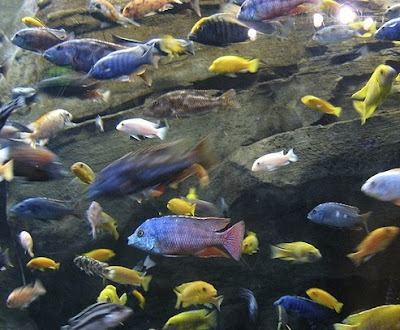
African Cichlids

breeding african cichlids.
African Cichlids


African Cichlids
Pearl of Likoma (Melanochromis joanjohnsonae)
King Size Cichlid (Pseudotropheus sp. 'kingsizei')
Zebra Red Top (Maylandia emmiltos)
Maingano Cichlid (Melanochromis cyaneorhabdos)
Kennyi (Pseudotropheus lombardoi)
Aurora Cichlid (Pseudotropheus aurora)
Powder Blue Cichlid (Pseudotropheus socolofi)
Demason's Cichlid (Pseudotropheus demasoni)
Fuelleborn's Mbuna (Labeotropheus fuelleborni)
Blue Cobalt Cichlid (Maylandia callainos)
Dogtooth Cichlid (Cynotilapia afra)
Perlmutt Cichlid (Labidochromis sp. 'perlmutt')
Hornet (Bumblebee) Cichlid (Pseudotropheus crabro)
Freiberg's Mbuna (Labidochromis freibergi)
Auratus (Melanochromis auratus)
Johanni (Melanochromis johannii)
Electric Yellow Labido (Labidochromis caeruleus)
Msobo Cichlid (Pseudotropheus sp. "Msobo")
Chipokee (Melanochromis chipokae)
Elongate Mbuna (Pseudotropheus elongatus)
Saulos's Mbuna (Pseudotropheus saulosi)
Red Zebra Cichlid (Pseudotropheus estherae)

Christmas Fulu Xystichromis phytophagus Victoria 6 inches Minimal Mbuna Spectacular male mating colors
Red Zebra Pseudotropheus estherae Malawi 5 inches Moderate Mbuna Very common in shops. Strangely, neither red, nor striped
Red Peacock Aulonocara hansbaenschi Malawi 5 inches Minimal Utaka Many variations
Zebra Obliquidens Astatotilapia (Haplochromis) latifasciata Kioga 4 inches Minimal Utaka Often sold as haplochromis obliquidens from Lake Victoria (but is not)
Msobo Metriaclima Msobo Malawi 6 inches Minimal Mbuna Males are blue, females yellow
Yellow Lab Labidochromis caeruleus Malawi 6 inches Minimal Mbuna
Blue Acei Pseudotropheus Acei Malawi 6 inches Minimal Mbuna Swims on the top, even though a mbuna

Breeding Bala Shark 11

The Bala shark (Balantiocheilos melanopterus) is among the most popular freshwater aquarium fish, being both very beautiful and easy to care for. Its coloring is dark silver with black margins along its fins, and for this reason it is also sometimes known as the tricolor shark or silver shark.
Bala sharks do well on a varied diet of standard fish food, vitamin-enriched flake foods, fresh vegetables, pellets, and live food such as mosquitoes or shrimp.
Breeding Bala Shark 11

The male fish is sleeker than the female. Bala sharks reach maturity at 9 inches and can grow up to 15 inches in length, making them among the largest aquarium fish. The males are sleeker than the females. Therefore, it is recommended that they be kept in a tank no smaller than 40 gallons. The Bala Shark originates from places such as Thailand, Borneo and Sumatra and have made their way around the world.

  • Keep in mind that the Bala Shark is not likely to breed without a spawning hormone. This hormone must be extracted from carp and then applied to your fish.
  • These fish reach maturity at 9 inches in length. The female will be much more chubby than the males.
  • Once you can distinguish between sexes, separate them so you can condition them for breeding.
  • If you do succeed at breeding the Bala Shark, remember that the babies are quite sensitive and can contract the "ich disease". 


Breeding Bala Shark 11


Breeding Bala Shark 11

Thursday, February 3, 2011

Summer is Here - Fighting Algae Blooms


New Betta! :D, originally uploaded by s.kosoris.
Summer is finally here and with it generally comes a more stable pH. Water treatment facilities will often do a flushing of the system in the spring causing spikes in chlorine and chloramine levels and unstable KH and pH levels. By the time summer rolls we tend to find less fluctuation in the water chemistry. Instead we are faced with the challenge of keeping our tanks from overheating and avoiding algae blooms from the extended sunlight hours.

If you are noticing more algae than usual with these longer summer days try moving your betta tank away from natural light sources like doors and windows. Remove any uneaten food or debris from the tank and increase your water changes. Nutrients from fish waste and decaying plant and food matter feed algae and can make it hard to keep at bay. Limit the light to 8 – 12 hours per day and reduce as necessary to inhibit algae growth. Monitor your water temperature daily, keeping it stable between 76 and 80 Fahrenheit.

Episode 1 - Water Changes and Betta Behavior


Hey gang,

Welcome to the first ever Nippyfish: A Betta Blog video blog. Today I tried answering our reader email over video but am also including written info for your reference. Let us know what you think.

Q: PM wrote,

Thank you so much for posting a lot of useful information online. I just got my betta fish a week ago and have been following your advice. He's doing quite well.

I have questions about my betta and would be very appreciated if you could get back to me.

1. I bought an ECLIPSE SYSTEM 3 (3-gallon tank with filter). I am wondering how often should I change the water and how much water should be taken out? Also, should I take my betta out of the tank before cleaning or just leave him in the tank?

2. I have been feeding my betta with Hikari Bio-Gold pellets. I feed him 1-2 pellets per day. I am not sure if I am feeding him a proper amount or underfeeding him.

3. My betta fish is relatively small -- about 1 1/3 inch long without tails. Is he normal?

4. I read your profile and found that you live in San Diego and I think you definitely could answer this question. I live in Santa Barbara and the weather fluctuates between low 50s to low 70s degree F in one day (outside temperature). I called the local pet stores and they said I can just keep him in the room temperature and he will be fine. Well, some online websites say that the best temperature of betta fish is 74-78 F because at this temperature range, a betta can live long. I am wondering whether I need a thermometer for my betta fish

5. After reading online, I found that flaring means he's angry because his territories has been invaded. But, how about the other kinds of behavior? I had him wag his tails vigorously at times without flaring. Do you know what this sign means? By the way, do you have information about betta fish behavior?

I am so sorry I am asking so many questions! It is because I trust you much more than other folks who set up betta websites just to sell their products. Thank you so much in advance!


A: A three gallon can either be cycled or you can do complete 100% water changes. If yo choose to clean the water completely each time, start by testing your water daily with an ammonia test kit. How often you need to change your water depends on a lot of factors so each tank is different. See how many days it takes for your water to register trace amounts of ammonia. If it takes 9 days, you know to change your water every 8 days before ammonia becomes an issue. Repeat the test periodically. If you do 100% water changes obviously you will need to remove your fish. In a cycled tank you can just change 10% - 20% of the water weekly and can leave your fish in the tank during cleaning.

1-2 pellets is probably not enough to sustain a growing betta over time. I suggest trying 2-3 twice per day and monitoring your betta. If he does well with that amount try adding another two pellets feeding no more than 8 - 10 in a day (split over a couple of feedings). If you betta shows signs of bloating you are feeding too much.

1 1/3" is a normal size for betta fish purchased at the store. These days it is common to find bettas for sale that aren't quite full grown. Over the next several months you will likely see you betta grow until he reaches about 2 - 2 1/2 inches.

I do recommend purchasing an inexpensive thermometer for your aquarium. Monitor your water temperature daily and watch for drastic fluctuations. Aim for a stable temperature around 78˚F. If you find your temperature fluctuating too much from day to evening you may need to consider a small aquarium heater.

Tail wiggling isn't completely understood but appears to be a good thing. Most bettas will wiggle their tails when you approach the glass or go to feed them. It appears they are begging for food. Tail wiggling seems to be most common in strong, healthy bettas with lots of energy and a good appetite so I would consider it a good sign.

Thanks so much for writing in and for being my very first betta fish video blog victim... I mean... participant.

Bright Colored Betta Fish - Vibrant Healthy Bettas


Gold Betta, originally uploaded by sponytales2000.
Q: D wrote,


I've looked around the net quite a bit and haven't found an answer to this one. As you're the enthusiast, perhaps you'll know. My betta started out life completely white with a red dot on his tail. After finding a nice home in my 20g tank with a few other social fish, he blossomed and turned gorgeous colors. And what I say turned, I mean it! He's been many different colors; the only thing that's been constant is that little red dot. At the moment, he's mostly all black including his lips. Is this normal? Please tell me my fish is just super happy and putting on a gorgeous display for my family and me. I'd love to hear what you think.

A: It is not at all unusual for bettas to change colors over the short and long term. Betta fish that have been living on a store shelf are often pale versions of themselves. This bland coloration is the result of stress caused by a small container, poor water quality and low water temperature. Once the fish is acclimated to a better living condition their true colors will come out (both literally and in terms of personality too). Within the first few days and weeks in clean warm water the fish will become bright and lively. This is a signal to you that you are doing a good job caring for your betta.

Bettas may also change color over the long term. Over the years your betta’s dominate color may begin to change. In some fish this change may be slight. A bright red betta, for example may begin to show some black coloration around his head but will often stay mainly red. Other bettas may show more extreme color changes. I had a green and blue betta that over the years transformed into a dark red. I have also seen young white bettas over time develop striking blue or pink coloration in their fins.

Often bettas will change color in certain parts of the body. Most common areas for color change are the head region. The crown of the head will often change to a dark black in darker colored bettas or a yellow or rust color in lighter betta fish. The area under the mouth often changes too. As a betta ages you may notice a graying or blander coloration. Betta fish keepers often refer to this as the “betta beard,” a sign that your fish is becoming an old man. The fins often change color too, particularly the tail fin (also called the caudal fin), the dorsal and anal fins. The pectoral and pelvic fins don’t typically have noticeable color changes.

Rapid color changes from bright vibrant color to dull or pale color may be a signal that your betta is sick. If you notice this sort of color change keep an eye out for other signs of disease and test your water.

It sounds to me that your betta has been through quite a change. I don’t think I have ever seen a betta go from white to black. If you have photos from before and after email them in and I will post them on the blog for all to see. This goes for any of our readers. Feel free to send in your color changing betta photos.

Here are mine:

Christie's Betta at 1 Year Old


Christie's Betta, Flash, at 3 Years Old


Christie's Betta, Bone, when I first got him.


Bone, later in life showing his golden crown.

Betta's Head Changing Color


Blue Fighting Fish, originally uploaded by Rae134.
Q: DH wrote,


I have had my betta Lapis for a little over a month now, and he's been through quite an ordeal. About a couple weeks ago he managed to get stuck against the old filter system I had in the tank and ripped his caudal fin to shreds. He's healing from that, thanks to help from my local mom and pop fish store's help. Up until Friday he was in a 5 gallon tank, but I had to replace it that morning because the 5 gallon was leaking. He is now in a 10 gallon tank, and this one has a light. I turned it on only for a few moments (honestly don't use the light, don't like the idea of algae growth) and noticed for the first time that his face is duller than the rest of his body. There appears to be no signs of ick, velvet, or cotton wool. He's swimming around like normal, eating normally, so there doesn't seem to be anything WRONG with him. I read on a website that they sometimes lose their scales due to stress, but that they might heal back. Is that true? Should I start another Melafix treatment? (I was using less than a half dose for a while for his fins; the small amount because I wasn't sure if he would be allergic or not)

Oh, and I forgot to mention he's now in a 10 gallon hexagonal filled only a little more than halfway. There's still an adult's hand-length from the top of the water to the top of the aquarium. I was worried about the water being too deep if I filled it up any more than that. He's also got a brand new Marineland Visi-therm submersible rated for a 10 gallon tank, and a Hydro-Sponge 1 sponge filtration system (which I put in after the old filter chewed up my poor baby). I live in a dorm-style apartment so unfortunately he's stuffed in my room, where I'm often moving about. I read somewhere that too much activity might stress him out... should I make a fabric cover for his tank so that he can have quiet times or something? Would that help him de-stress?

I'm including a link to a picture of what I mean about his scales. You can also see how his caudal fin is still a little tattered... it's amazing that it's healed so well in just about two weeks. I'm glad I didn't listen to one of the other betta enthusiasts online because he was pushing the use of antibiotics and saying that Melafix wouldn't do anything. (I think he was wrong on that one.) This is Lapis Lazuli or "Lapis" for short. I named him that because his coloring often reminds me of the precious stone.

Also, I noticed on your website you suggested that people not add unnecessary chemicals to the tank, yet quite a few betta enthusiasts have recommended API Stress Coat as beneficial to keep the water conditioned for bettas. Should I discontinue using this? I'm on city water and I worry about the chlorine.


A:Thanks for writing in and for sending the link to the photo of Lapis. The good news is I don’t see anything out of the ordinary and your betta, from the photo anyway, looks completely healthy. The dark coloration around his head is very common among bettas and is completely normal, especially for blue betta fish. After bettas adjust to their new surroundings they often begin to show their true colors and most often this means their colors get darker and more saturated. I believe you are just seeing Lapis with his natural and healthy coloration. Even his fins look almost completely healed. You may also find that the light will affect your betta’s coloration. Turning a light on will tell your betta it is time to wake up and hunt. During the day, your betta’s color will darken and become richer. When it is dark they will go to sleep and become pale. While you don’t need a light in your betta tank it is good to make sure he is getting at least ambient room light so that he can maintain his natural rhythm of waking and sleeping.

You can also feel free to fill up that 10 gallon aquarium. While Betta fish may be able to survive in shallow water they by no means require it. It will give him more room to roam and enjoy his surrounding and give you a little more time between water changes. Ten gallon tanks are great for bettas. It’s what I use at home too. You might even get an itch to add a small tankmate or two down the road, which you will be able to do once your tank has cycled.

Oh, and regarding your water conditioner question... A conditioner that neutralizes chlorine, chloramines and heavy metals is absolutely necessary if you water has them. That is something you want to keep using.

Thanks for writing in.


Photo of Lapis by DH

Betta Fish Poll Results: Which Common Betta Illness has you Stressed?


tema röd, originally uploaded by miluhe.
In the last Nippyfish Poll we asked our readers; which common betta illness has you stressed? The results are in and they are all over the board.


54% (13 Votes) Fin Rot
25% (6 Votes) Swim Bladder Disorder
12% (3 Votes) Parasites (Ich, Velvet, Etc.)
20% (5 Votes) Fungus (Cotton Wool or Others)
20% (5 Votes) Dropsy
16% (4 Votes) Bacterial Infection (Septicemia, Popeye, open wounds)
8% (2 Votes) Other


It’s no surprise that more than half our readers are battling fin rot. Bettas, with their long and flowing fins, are prone to this bacterial infection which is caused by poor water quality. To prevent fin rot, test your aquarium water regularly for ammonia, keep up with your regular water changes and remove any uneaten food and waste from the tank bottom and anywhere that your betta may drag his tail fin. Most fin rot is minor and is treatable without medication. Minor fin rot consists of lightly tattered fins, bloody fin tips or pin holes. More severe fin rot may need to be treated with a wide spectrum antibiotic. We define severe fin rot as rapid or significant fin loss (more than half the fin has fallen away).

This weeks Betta Poll: Do you name your Betta Fish?

Shatterproof Aquarium Heater is my new BFF


I have gone through many different aquarium heaters over the years and my reason for buying a new one is always the same… because I have smashed the old one to bits. Any glass that goes in my aquarium will inevitably explode into a thousand tiny shards to nobody’s fault but my own. My old Ebo Jager 100 watt semi-submersible is the latest to fall prey to my carelessness. I decided last weekend to do a really thorough scrubbing of my larger aquarium – a spring cleaning if you will. I took out all of the tank décor and removed the heater so I could really scrape the glass clean in those hard-to-reach areas. Balancing the heater on the top of the tank I momentarily though better of its chosen resting place but dismissed my initial concern vowing to “pay attention to what I am doing and it will just fine sitting on the edge of the tank.”

Of course, 10 minutes later as I was wrestling with a particularly stubborn patch of lichenous algae I unintentionally elbowed the heater off the tank, across the room and into the wall with such gusto that I actually heard the impact even before my reflexes respond. I could even hear the light tinkering of tiny shards as they fell down the wall, across the furniture and onto the floor, like the sound of miniature wind chimes. The heater slid behind an old mirror coming to its final resting place out of immediate view. Oh the horror. Aquarium heaters, relative to the rest of the hobby, aren’t particularly expensive but Ebo-Jager has a reputation for being pretty top-of-the line, at least in terms of what you can easily find at your local fish store. When I bought it more than a few years ago I was sort of proud of it. Most of my aquarium supplies are hand-me-downs bough on Craigslist or from tropical fish club meetings and here I was investing in a nice new piece of equipment that would last me for years. I suppose I’m lucky I didn’t break it sooner.


The nice surprise is yesterday; my hunny (Mr. Nippyfish) called to say he was going to pick me up a new heater for my tank. He was the first to come running when he heard the eruption of glass hitting the wall and my subsequent string of four-letter words. I was more than pleased and when he asked what brand I liked (he’s not a fish guy) and of course went on about wanting another Ebo-Jager to replace the broken one. When he got home, however, what awaited me was a Marineland Visi-Therm Stealth Shatterproof aquarium heater. Hmmm, ok. I have had Marineland Visi-Therm heaters before. I’ve shattered many of them in fact. Back in the day they weren’t known for being particularly accurate and did have some problems getting stuck “ON”. They also didn’t used to be shatterproof. Still, I have never had a shatterproof heater before and I have to admit, if there was ever an ideal candidate for one, it would be me. Besides, it’s been awhile and this new heater will give me the chance to provide another product review. Tonight I will turn the heater on and will watch it closely over the coming weeks and months and with some luck for years to come.

Betta Tail Injured by Aquarium Net


Undersea Tiki Betta, originally uploaded by pixelator_1999.
Q: DA wrote,


Hello! I have found so much useful information from your site. Thank you for all of the time and hard work that you put into it!

I have had this little guy for two weeks. He was in a small bowl, that I did water changes on every 2 days. When I bought him his tail already had a "fringe-y" look to it, but did not seem to be anything wrong to me. He eats good, and has been acting healthy. I did damage his tail while moving him to clean his bowl, :( It was a rookie mistake, and it looks like someone to a bite out of it. "net happens" is now our slogan...

Two days ago, I got him moved into a 6 gal eclipse tank. He LOVES it! I didn't know bettas were such active fish. He has been playing in the current, and just having a great time. My question is that I am worried about his tail....is it getting fin rot? or am I just being an over protective mother?

I have been using stability everyday to build up the good bacteria in the tank. (It says to use it for the first 7 days) I also used Prime, and 1/4 teaspoon of aquarium salt. I tested the water today. PH 6.8. Nitrite 0, Nitrate 0, Ammonia 0. Tank temp is holding steady a 79 degrees. Right now all I have are a few silk plants, and gravel. I want to do a planted tank later. I have not done a water change yet, will do so when ammonia levels rise. He is getting pellet food, 3 to 4 pieces everyday, and freeze dried blood worms a couple times a week. At this time he is the only fish in the tank.

The only other thing I can think to add, is that he only flairs on one side. It looks like a deformity. When he sees himself in the mirror, he gets all "puffed -up" and flairs, but only his right side opens up. Have you ever heard of this before?? It doesn't seen to bother him, and he acts normal...so I figured birth defect.


DA's Betta Fish


A: Wow, D, your new 6 gallon tank set up sounds great and your water parameters are spot on for your betta fish. For a “rookie” as you called yourself, you are certainly on track for success.

Thanks too, for sending the photos of your betta fish. I can see exactly where you clipped his fin with your net. The good news is I don’t think it is turning into fin rot. On the contrary, it appears he is growing some new fin tissue. In the photo below you can see some very fine cellophane-like webbing beginning to grow where he lost the chunk of fin. That is new growth. It will likely take a couple of months before he has his fin completely healed but as long as you keep his water clean and your betta healthy, you should notice rapid improvements in the next couple of weeks.


Betta fish tail fin regrowth


Of course, I should mention that new fin tissue is extremely fragile. It is not unusual for bettas to lose their new fin growth due to reinjury or fin rot. Be gentile with that net during water changes and keep his water warm, clean and stable.

Best of luck


Photo of DA's Betta

Marble Betta Fish - Color Changing Genes


, originally uploaded by prismaviolet.
In our last article we spoke about bettas that naturally change color over time. A Nippyfish reader wrote in concerned about some pretty serous color changes. Well, she sent in some photos of her betta fish and it became immediately obvious that she has a Marble Betta. “Mable” is used to describe a type of betta fish by its physical “marbled” appearance but more importantly by the special genes they have called, jumping genes or Transposons as they are now called.

These Transposons are what make marble bettas notorious color changers. Genes are responsible for a variety of things. With bettas, we study genes to understand and modify (through breeding) particular traits like color, pattern and fin style. A royal blue betta is blue because it has the blue gene. Transposons have the ability to do two important things that affect a betta’s color:


1. Insert itself into another gene and change its function. For example, it can insert itself into that same royal blue gene effectively saying “you no longer produce color” therefore changing its function. The gene no longer acts to produce the royal blue and the betta becomes colorless in part. Some jumping genes can also change the color which means some bettas can go from one color to a completely different color over time.

2. The second important function of a jumping gene is its ability to… well… jump of course. Through the chromosomes these genes can move reinserting itself into other genes. This is what allows a marble betta to change continuously over the course of its life. Let’s go back to the example of the royal blue betta. The blue gene was overridden by the Transposons creating a loss of pigment. When the jumping gene moves on, the blue gene returns to its normal function and the blue pigment returns. When the jumping gene moves to another location, it may then override the function of the new gene.


It is my understanding that the Transposons is a genetic trait specific to marbled bettas, which makes them more likely to illustrate a greater variance of color change throughout their lives. For hobbyists, keeping marbled betta fish is fun and exciting. For betta breeders, these can create unique challenges as it is difficult to predict what they will get. Over time, some marbled bettas may turn completely solid or loose color entirely.


Our Reader's marbled betta fish 6 Months ago

The same betta 3 months ago

The vary same betta today

Betta Fish with Lump on his Head


Lump on Betta's Head provided by LH


LH wrote,

I’ve seen your site and figured I’d get an opinion on my fish if you don't mind taking the time. I’ve had him since the end of January and about a month after I got him, he had a spot on his face that just grew. I thought it may have just been a scrape but it hasn't gotten better, just worse. I tried to avoid medications because I’m scared of them doing more harm then good, but the lump on his head just seemed too big and kind of cottony so I treated him for fungus. It didn't really help much. For the most part he has been on a diet of brine shrimp. He lives in a filtered 5 gallon tank that and I do about an 80% water change every 2 weeks and treat the water with aquarium salt. His appetite is healthy, but I would really like to do something about his problem before it gets too bad. Lately I’ve been trying salt baths, but over the last one, he lost too much colour too quickly. Today (before said salt bath) I had noticed that little white bits were a part of his lump too. I took some pictures, I will enclose the best.

A follow up with your opinion would be appreciated. Thank you for your time

(He doesn't have any other dots on his body, those are just bubbles) he also had a bit of fin rot off and on, but it never got too bad. Right now his fins are in good shape. He a little bit lethargic and has trouble keeping balanced, but he is still enthusiastic.


A: Most betta illnesses can be easily identified but occasionally I get one that really stumps me. The Nippyfish reader above sent in this photo of her betta showing an unusual lump on his head with specs of white. I have speculated that it could be a tumor or perhaps a parasitic infestation of some sort. Despite what you may read on some websites, tumors are not very common among bettas. Most of the time lumps can be attributed to constipation or fluid retention which is commonly misdiagnosed as a tumor. This, however, is neither of those. The white specs are also unusual, which makes me think it could be parasites. Is it possible the lump is filled with some sort of bug which we are seeing poking through the scales? Perhaps gill flukes? It does appear to be near the gills but it is hard to tell if it is an infection of the gills specifically. Could the white we are seeing be the result of slime coat build up from the salt baths? I am just tossing out ideas because truthfully I don’t really know what has caused this. I’d love to hear our readers’ thoughts and ideas as well. Have any of you seen this in your fish?

Woops! Betta Food Dumped into Fish Tank


my gold crowntail, originally uploaded by louie imaging.
Q: EB wrote,


I’ve had my betta fish for a couple months; it was a gift from a friend. Usually he shows the usual healthy signs but I noticed that his color has dimed and he doesn’t have that shininess to him anymore. His eyes aren’t clear and seem clouded. He also seems a little uninterested in food but he will eat. One day I was gone and my sister poured a bunch of dried food into his tank (like over 25 pieces) when I had already fed him that day. I didn’t notice all the food floating in his tank until night time, so I cleaned it out right away. My sister said she saw him eat some so I was afraid that he overate and that he would die. He is still alive showing the same unhealthy signs. He still makes bubble nests but he seems even more uninterested in things and when I go to feed him he will attempt to eat but it’s like he can’t see very well because he will miss getting the food in his mouth several times, Today he only ate one piece of food and he will look at the other pieces but it’s like he gives up on trying to get it. So I found the Nippyfish site and thought about writing you. What do you think I should do to get him healthy again?


A:You did the right thing by changing the water as soon as you noticed all the food had been dumped. (I’m guessing you have a little sister. People email about these things all the time.) While it is possible he overate that day it is not likely that he could eat himself to death. Bettas are opportunistic in that he took advantage of all that extra food by pigging out not knowing when his next meal was coming. Now he is overfed and feeling sluggish, not to mention he spent the day swimming in dirty fish-food water. I recommend keeping his water clean, like you have been doing, and giving him a break from food for one or two days. Bettas, being cold-blooded animals, won’t die from a day or two without food. After a couple of days (after he poops), offer him a small amount of food again.

The cloudy eyes could be caused by the food breaking down in the water, particularly if the tank is quite small. Keep his tank clean and increase your water changes. In a week or so his eyes should begin to clear. If his eyes get worse or he shows any signs of swelling in the eyes you may need to treat for a bacterial infection, but as for now I recommend concentrating on keeping his water clean. Also, the cloudy eyes could be the result of chlorine burns. If you are not, make sure you are treating your tap water with a dechlorinator. (I am guessing you probably already are.) If his symptoms don’t improve in a week you should see about testing your tank water with an aquarium water testing kit. I hope he feels better soon.

Elevated Ammonia Levels in Empty Aquarium

Q: CD wrote,


I've started my cycling experiment with a 1 gal betta bowl (no fish, of course - he's in a different one). So far, so good. The ammonia got up to over 1.0ppm (not quite 2.0, but greener than the 1.0), and today it was down to the 0.5ppm color. I've added more old tank water (searched for two weeks, but couldn't find any ammonia to buy), and so now I have another
question - what do I do to test for nitrates? Do you know of anything that is better than strips, or are strips ok for what I'm doing?

When I started the cycling bowl, I thought I'd try something else. Here's the back story: when I first set up my bowl, it got murky within two days. Curiously, it did that again when I used new rocks in my fish bowl. I tested the ammonia, even though it had only been like 3 days, and sure enough, the ammonia was already at 1.0ppm. The only thing different from previous water changes (where the level was bearly even 0.5ppm after 8 days) is the new aquarium gravel. This has got to be it, but why? And if it's causing dangerous levels of ammonia in my system, shouldn't there be some warning on the package or something?


A: Ammonia itself is formed as the result of decaying organic matter. If you are not adding the ammonia yourself from a bottle or getting it from something alive (or once alive) in your aquarium then it must be coming from an outside source like your water. Rocks and gravel are not organic and cannot produce ammonia. It is not unusual, however, for your water supply to have some ammonia in it. There are a few common reasons why you may detect ammonia in your water even if you are not adding anything that creates ammonia (like fish or decaying plants or fish food).

1. Existing ammonia in your water supply. Many of us will find ammonia in our tap water if we test it directly from the sink. Registering .25 - .5 ppm (parts per million) is very common but others have indicated even larger concentrations of ammonia of up to 1.0 ppm directly from their tap water. It is a good idea to test your water from the tap a couple of times per year, especially in the spring when municipal water companies flush their water supply (sometimes this means an influx of chlorine or a spike in pH).

2. Another reason for finding ammonia in your tank when you haven’t added any fish or ammonia directly is the type of water conditioner you are using. First you need to understand how water is treated. These days most water is treated with chloramines. Chlorine is used too but the disadvantage of using chlorine is that it doesn’t last long. Once exposed to air chlorine quickly breaks down and no longer protects your drinking water from harmful bacteria. Chloramines are created from chemical bond between chlorine and ammonia. The old way of conditioning tap water for aquarium use was to just let it sit out in a bucket with an airstone in it. The chorine would break down after one day and it was safe to use. With today’s chloramine treated tap water the aeration method is no longer safe. Now we need water conditioners that treat chlorine and chloramines to make the water safe for our fish. Not all water conditioners are created equal. Some will break the chlorine/ammonia bond and neutralize the chlorine leaving the ammonia (NH3) in the tank. As you can imagine this ammonia is dangerous for your fish. I like to recommend Kordon’s AmQuel+ and NovAqua or a similar conditioner that not only breaks down the chlorine but also binds the ammonia into a non-harmful form. We call this binded form, which is not toxic to fish, ionized ammonia or ammonium (NH4+). If you don’t use a water conditioner that binds the ammonia then that ammonia will register on your ammonia test kit. You are basically creating the ammonia by separating the chlorine/ammonia bond every time condition your water.

3. The third reason you may be seeing ammonia in your empty tank is due to the type of ammonia test kit you are using. There are many brands of ammonia test kits and methods for testing ammonia but some test kits will test for just dangerous NH3 Ammonia while others measure the total ammonia; both NH3 and NH4+ ammonium which was described above. Ammonia test kits that measure both use the Nessler method. These test the total ammonia both harmful and binded form. If you add water conditioner to your aquarium that binds dangerous ammonia a Nessler based test kit will still register it on the test. This type of test kit might be useful if you are really interested in seeing what is going on in your tank while it is cycling. The nitrifying bacteria in your tank will consume both the dangerous ammonia (NH3) and ammonium (NH4+).

If you don’t realize you are using a Nessler test kit you may be worried at the amount of ammonia you are seeing when really it is the nontoxic form that is registering high. The type of test ammonia test kit most people use is a Salicylate based ammonia test kit. This type measures only the dangerous ammonia (NH3) in our aquariums. I have sent an email to Aquarium Pharmaceuticals to get an official response regarding how you tell from the package if the test kit is Nessler or Salicylate based. I am curious if the box says NH3/NH4+ if it is Nessler based. I should hear back within a week and will repost.

To answer your question about nitrate test kits: when you are getting started dip-stick tests are fine. They are cheap and convenient and personally I believe that water testing is such an important part of fish care that I never want to discourage anyone from doing it. Reagent based test kits are better as they are definitely more accurate. Reagent based kits come with a test tube and one or more reagent bottles with various liquids for testing. The cost varies quite a bit on those depending on the brand and the type of test you are running (anywhere from $6 to $30 per kit- the higher price tag is usually for saltwater tests.) I use these kits and swear by them. That said; dip-stick tests are still better than not testing at all.

Helping New Betta Fish Owners Start Off Right


Betta1, originally uploaded by ~VLC~.
Q: JP wrote,


Hi Christie!

I recently discovered you site and have a few questions....

A couple of days ago, I received a betta fish for a Christmas present. I am very excited, but want to make sure that I take good care of him. I got a small bowl with him... but its only 1 gallon... I know you said 2.5 was the smallest you would go. What do you think? Also I’m worried about temperature. Do they sell water heaters for small fish bowls?

If you could answer my questions that would be great. Thank you!


A:

Good for you for taking the time to research your new betta fish. This is the busiest time of year for me as I get tons of emails from new fish owners who have received a betta for the holidays.

To get to your question; it is difficult to keep a betta healthy in a small unfiltered and unheated bowl. Success is based more on luck and good genetics than anything else. Initially, keeping your betta in a small bowl may seem like the easiest thing to do but in actuality you are setting yourself up for difficulties from the beginning. Small volumes of water are unstable. They quickly fill with toxic ammonia from fish waste and the temperature in small bowls is especially erratic. Fish, more than anything, need a stable environment to thrive. A 1 gallon bowl needs constant attention, water changes and testing and even if you have the time to do the work it can still be impossible to keep stable.

I recommend doing it right from the beginning, which is really easier than you may think. There are lots of great starter aquariums available for not a lot of money. I recommend the small 5 gallon Aqueon Mini Bow or the 6 gallon Marineland Eclipse.

They are both sturdy desktop aquariums with an internal filter system, a light and a lid to keep in bettas which are notorious jumpers. Hope this is helpful and that you enjoy your new Betta. Happy holidays!

New Betta Fish is Sluggish and Not Eating


Red Rum ( Half Moon Betta ) !, originally uploaded by q8phantom.

Q: H wrote,


Hi there -

Firstly, I wanted to say that I've been reading your (beautiful) site for a while now, before I bought my first betta, and it helped tremendously – many thanks!

Secondly - I'm hoping you can give me some advice or suggestions. My betta came home on Saturday of last week, with four WCMMs (White Cloud Mountain Minnows), from a really good LFS (all of the fish there are beautiful – well cared for, alert, interested in their surroundings and playful - and the store owner and I spent some time discussing the ailing plakat in the shop's hospital tank). The betta had been in with a tank full of neon tetras, and had been absolutely unperturbed - they left him alone, and vice versa - so I'd no compunctions in letting them all move into their new home (63 litre Juwel Rekord tank) together. It's well planted, has an inch or so of gravel substrate and two big chunks of bogwood. For the first three or four days, all was great - they were all as bright and alert as they had been in the shop, and were all eating well. Around Wednesday afternoon, the betta started to display less interest in food. Overnight he became increasingly listless and remains so now.

The tank is fully cycled, and the ammonia and nitrites have both been 0 consistently (I've been monitoring it carefully). The nitrates have been high so I've done several largish water changes, but the result remains high (40-50). Until Tuesday this didn't seem to be affecting any of them, so I stuck to water changes, but yesterday I tried adding several doses of Tetra EasyBalance which professes to have nitrate minimizing granules in it. It doesn't actually seem to be minimizing anything, but I figured it was worth a shot.

I use Seachem Prime as a dechlorinator, but try to avoid too many additives, so it's just been the Prime and the EasyBalance.

I've made sure that the water has been up to temperature by boiling a kettle and adding it to my bucket of tap water, before adding the Prime and adding it to the tank, to ensure no nasties from the hot water pipes infiltrate the tank.

I did a really big water change today, which cleaned out a load of plant debris from a few of the aquatics which haven't quite made it, and pruned a few others, but the nitrates remain around 25-50 (I'm using the API test strips).

The betta remains listless, hanging out in the foliage near the surface of the water. He's not eaten since Wednesday, when I tempted him (for the first time) wih a mouthful of Tetra Fresh Delica whole bloodworms "in a nutritious, vitamin-rich jelly". This was a one off - ordinarily he gets Hikkari pellets or what I assume are freeze-dried bloodworms, courtesy of the LFS, both of which he was eating happily until Wednesday. His change in demeanor coincides with this meal, but I can't see any obvious signs of infection (but then, I'm more used to checking for infection in creatures
with fur). He almost looks a little "tucked up" (a term I ordinarily associate with horses) - could he be constipated, d'you think? Attached is a pic I've just managed to snap as he came out of his foliage for a brief spell.


Photo of actual Betta by reader


This is pretty much straight out of the camera - I boosted the exposure slightly to get rid of the shadow on his belly, but his colours haven't really changed since I got him. I can't see any spots, light or dark, or discoloration, and I can't see any sort of damage to his fins, or any bloating, either. He's really just thoroughly disinterested in everything.

The minnows, of course, remain bright and bouncy!


A:
I read your email and looked closely at the photo of your betta that you sent me. From the photo, I can not see anything obviously wrong. On the contrary, his color, size and shape are good and his fins are spread normally. He looks healthy. That said, obviously listlessness and loss of appetite are not normal and you are right to be concerned.

High nitrates over time certainly could be the problem. Test strips are not particularly accurate, but if the actual nitrates are hovering around the 50 ppm mark, like they say, I believe they can be a factor. Unfortunately products claiming to reduce nitrates don’t really work, as you noted yourself. Water changes are truly the best (and most cost effective) means for reducing nitrates. Continue with your frequent water changes until you get them under 20 ppm. Even once they are there, a change in your betta’s behavior may not be immediate.

I am also curious about your water temperature. You mentioned that you heat the water during water changes to match the new water with the tank water, which is great. What is the water temperature typically at and how much does it fluctuate throughout the day/night? Do you have an aquarium heater running? Water that is consistently too cool will certainly lead to sluggishness and even appetite loss as the fish’s metabolism slows down. If possible, run an aquarium heater at around 78F (25.5C).

You may also benefit from testing your water’s pH level. Fluctuating pH or pH that is extremely high or low (alkaline or basic) may lead to similar behavior. If it is normal and consistent it is one more thing you can rule out.

Fish food born illnesses are possible. They tend to be more common when the foods are wild caught or when not properly stored. For example, when frozen foods are left to thaw and then refrozen or are unrefrigerated for longer than they should be. If kept properly, most manufactured products especially brand names like Tetra, are pretty safe.

Hopefully I was able to give you a few things to consider. I know it has been some time since you wrote so if you get a chance, let me know how the little guy is doing. Hopefully he is feeling better.

Betta Fish Won't Eat From the Surface

Q: EW wrote:


I have had betta fish before, and I get them from my local pet stores (in those horrible little bowls) I usually have to wait a couple days for the betta to start eating and acting like a normal betta, but my most recent, Rudy, will not eat food from the surface. He really likes the food as it is falling to the water, but he won't look up to the surface when I feed him, I am worried only because this has never happened before and I don't want him to be underfed b/c he won't go to the surface to find food. What should I do?

I have tried pellets, flakes, bloodworms and brime shrimp. He likes the flakes when the sink, but then the water gets filthy faster.


A: If it is important to you to feed your betta at the surface then you can try conditioning him by feeding the same type food consistently at the same location. If needed, try several times per day until he anticipates food at that location. If after a few days your betta hasn’t picked up on the new plan then you may want to cater to his instincts and allow the food to sink. Food that sinks won’t necessarily foul your water any quicker then floating food. The issue is rotting organic debris. As long as he is eating the food and not allowing it to decompose in the tank, you should be able to get by with your regular water changes. If your betta is leaving some food behind you can remove it 15 to 20 minutes after your initial feeding with a turkey baster. You may also want to look for other things that may be keeping him from noticing the floating food, like bright overhead lighting, strong filter current or dense surface vegetation. It could be that he just isn’t seeing the food until it has begun to sink.

Betta Fish Twitching


I have a question about my betta fish and, because your site is so informative, I thought you would be a great resource. I’ve had my little betta, Sam, for about 3 weeks. He lives in a 2 gallon tank filled with tap water and conditioned with TopFin Betta Water Conditioner. I have a thermometer and his water temp is usually between 76 and 78 degrees. I have a small filter that I run once a week. When it’s running, the current is so strong that he struggles to stay in one place, but his tank is clean. Every day I feed him 3 freeze dried bloodworms and he’s happy about that. He seems healthy, he swims a lot and he greets me. The past couple of days though, his swimming seems different. He seems a little jittery. Almost like he’s twitching. I haven’t made any big changes to his environment or water and I can’t seem to figure out why he is swimming like that. Is this normal? I did a little research and he doesn’t appear to have an illness. He has very colorful scales, long and colorful fins, no fungus, dark eyes and I don’t see any white spots. Maybe you can help me. I just want to make sure he is comfortable and happy.

A: If your betta fish begins twitching irregularly it may signify an external parasitic infection like Ich or Velvet or may be an indication of water quality problems like the presence of ammonia or chlorine irritation. Whenever your betta’s behavior changes from what is routine, it is a good idea to give him a thorough look over and test your water parameters. Ich has the appearance of small white salt like granules stuck to your betta’s head, body and fins. They are easy to spot and if untreated can become serious. Velvet is a similar parasite but harder to see with the naked eye. It often appears as a rust colored dusting on the betta’s head and body. It can also look brownish, gold or red in color. It is often easier to see with a flash light as the parasites will sometimes have a little sheen to them. Again, it appears more like a sprinkling of fine powder.

You should also test your water for dangerous toxins like ammonia, nitrite and nitrate with a freshwater aquarium test kit. If you don’t have one, call your local fish store to see if they will test it for you for free if you bring in a sample. Most will do free water testing for their patrons. Rapid changes in pH may also lead to behavioral changes like twitching. It is always good to have a pH test kit handy as even small variations in pH over a short time can be problematic. While I do not recommend pH adjusters like pH Up or pH Down, it is good to know if your pH is fluctuating. Often, simply allowing your new change-water to sit overnight in a container will be enough to stabilize the pH before your water change and will do it without harmful pH chemical agents.

LinkWithin

Related Posts Plugin for WordPress, Blogger...